
Axon Navigation
Studies in drosophila have shown that insect midline cells express netrins, as well as membrane bound repellents, called slits and semaphorins (semas). As shown in the below image, the neuron is able to cross the ventral spinal cord, which is expressing the repellent cue sema, before crossing the floor-plate, but is repelled by the same signal after crossing. This suggests that crossing the midlines changes the axons sensitivity to the slits and semas. This is due to a change in receptor trafficking.
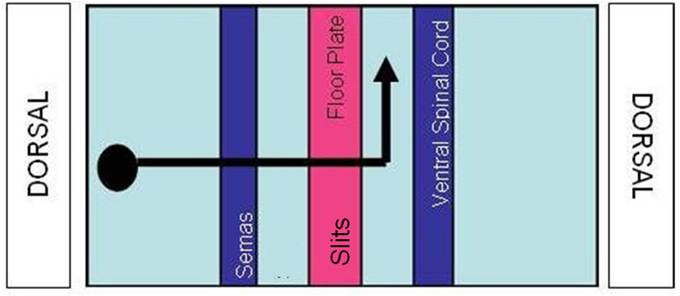
Molecules Involved in Crossing the Midline
In drosophila some axons cross the midline, forming commissures, and then turn to join the longitudinal path (as in the above image). However some axons do not cross the midline. Why does this happen?
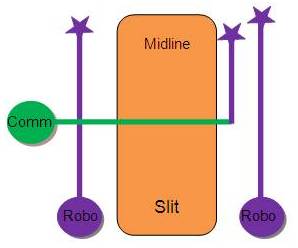
- The Robo (roundabout) gene encodes a receptor for the inhibitory protein slit (remember slit is bound to the midline cells).
- Axons that express a high level of Robo, and therefore the slit receptor, are repelled by the slit present on the midline cells. These axons do not cross the midline.
- The Comm gene encodes a trafficking protein that prevents the Robo gene product (the receptor for slit) from reaching the cell surface.
- Axons that express high Comm do not show the receptor for slit on their membrane, so are not repelled by slit and these axons do cross the midline.
- Once these axons cross the midline, Comm expression is down-regulated, allowing the slit receptor to reach the membrane.